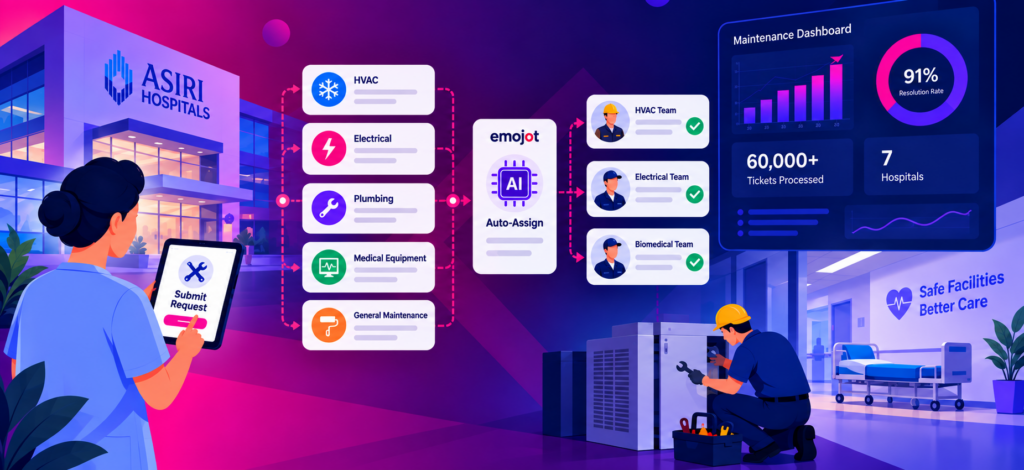
Asiri Hospitals operates a complex healthcare environment where the reliability of facilities and equipment is essential to maintaining smooth hospital operations and supporting patient care. Maintenance teams must manage a wide range of issues, including HVAC, electrical systems, plumbing, general maintenance, and critical medical equipment.
To improve the efficiency, visibility, and accountability of these operations, Asiri Hospitals implemented Emojot’s Facilities Management System.
Business Challenge
Asiri Hospitals previously relied heavily on manual and paper-based processes to manage facility maintenance requests.
As the hospital network grew, this approach created several operational challenges:
- Delays in reporting and responding to maintenance issues
- Limited visibility into the status of ongoing maintenance work
- Communication gaps between hospital staff, supervisors, and maintenance teams
- Difficulty assigning requests to the appropriate technical teams
- Limited ability to track recurring issues and maintenance performance
- Increased risk of human error
- Difficulty managing different types of requests across multiple hospital locations
In a healthcare environment, delays involving HVAC, electrical infrastructure, plumbing, medical gas systems, or medical equipment can have wider operational implications. Asiri therefore required a centralized system capable of managing maintenance requests from reporting through resolution.
The Emojot Solution
Emojot deployed a centralized Facilities Management System across seven Asiri Hospitals to digitize and automate the maintenance workflow.
Instead of relying on manual processes, hospital staff could report maintenance issues through desktop or mobile devices. Once an issue was submitted, the system categorized the request and routed it to the relevant maintenance team.
The solution supported multiple maintenance categories, including:
- HVAC systems
- Electrical infrastructure
- Plumbing systems
- Medical and biomedical equipment
- Operating theatres and related medical facilities
- Intensive Care Units (ICUs) and critical-care facilities
- Laboratory and diagnostic facilities
- Medical gas systems and infrastructure
- Painting and general maintenance
- Other hospital facility-related requirements
Automated alerts and escalations through SMS and email helped ensure that relevant personnel were informed of new issues and outstanding tasks.
How the Workflow Works
The Emojot FMS introduced a structured digital workflow:
Issue Reported → Issue Categorized → Assigned to Relevant Team → Maintenance Action → Real-Time Status Updates → Resolution & Closure → Reporting & Analytics
Staff can submit an issue through mobile or desktop. The system identifies the appropriate maintenance category and routes the ticket to the responsible team.
Maintenance personnel then take action, while supervisors and administrators can monitor progress and status updates. Once the work is completed, the ticket is closed and retained within the system, creating a traceable maintenance history.
This provides greater accountability and visibility from the moment an issue is reported until its resolution.
Real-Time Operational Visibility
The Operations Intelligence Dashboard gives administrators and supervisors visibility into maintenance activities across the hospital network.
Teams can monitor information such as:
- Open and closed maintenance tickets
- Ticket status
- Response and resolution times
- Recurring maintenance issues
- Maintenance workload and performance
Rather than relying solely on manual records, administrators can use operational data to identify bottlenecks, understand recurring problems, prioritize critical maintenance activities, and allocate resources more effectively.
Results
Since its implementation in August 2020, Emojot’s Facilities Management System has supported the management of thousands of maintenance activities across Asiri Hospitals.
- 60,000+ Maintenance tickets processed
- 91% Ticket resolution rate achieved by 2025
- 7 Hospitals Supported through the centralized FMS deployment
Beyond these metrics, the solution helped Asiri Hospitals establish a more structured and transparent approach to facility maintenance.
Business Impact
The implementation delivered several operational benefits:
Faster Maintenance Response
Digital reporting, automated routing, and real-time notifications reduced unnecessary delays between identifying an issue and assigning it for action.
Greater Accountability
Each maintenance request could be tracked through its lifecycle, giving supervisors greater visibility into ownership and progress.
Improved Team Coordination
Automated categorization and routing helped direct issues to the appropriate teams, reducing manual coordination between departments.
Better Resource Allocation
Dashboard insights enabled administrators to understand maintenance workloads and prioritize resources based on operational requirements.
Reduced Manual Work
Digitizing maintenance requests reduced reliance on paper records and manual communication.
Improved Infrastructure Readiness
Faster identification and resolution of facility issues helped maintain the infrastructure required to support day-to-day hospital operations and patient care.
From Reactive to Data-Driven Maintenance
One of the most significant changes was the ability to move beyond purely reactive maintenance management.
Previously, maintenance teams depended heavily on manual reporting and communication. With Emojot FMS, issues could be captured immediately, assigned systematically, monitored centrally, and analyzed over time.
Recurring issue patterns also provided management with information that could support preventive maintenance and operational planning.
This transformed individual maintenance requests into useful operational intelligence.
Implementation Approach
Emojot followed a phased implementation approach to support adoption across the hospital environment:
- Process Audit & Gap Analysis
Existing maintenance workflows and operational gaps were assessed. - Pilot Deployment
The system was introduced within a controlled environment to validate workflows and collect user feedback. - Workflow Customization
The solution was configured according to Asiri Hospitals’ maintenance categories, responsibilities, and internal processes. - Multi-Hospital Rollout
The platform was expanded across seven hospitals. - Continuous Monitoring & Improvement
System performance and workflows were continuously reviewed to support evolving operational requirements.
Emojot Support
Emojot supported Asiri Hospitals beyond the initial implementation through:
- On-site and virtual user training
- Workflow customization
- Technical and operational support
- Continuous consultation
- System enhancements based on operational requirements
This helped hospital teams integrate the system into their everyday maintenance processes.
Use Case Summary
Challenge:
Manual and fragmented maintenance processes made it difficult to efficiently report, assign, monitor, and analyze facility issues across multiple hospitals.
Solution:
A centralized Emojot Facilities Management System that digitized maintenance reporting, automated ticket categorization and routing, enabled real-time alerts and tracking, and provided operational dashboards.
Outcome:
More than 60,000 + maintenance tickets processed since 2020, achieving a 91%+ resolution rate and improving visibility, accountability, and operational efficiency across maintenance operations in seven hospitals through 2026.
Conclusion
By implementing Emojot’s Facilities Management System, Asiri Hospitals transformed maintenance from a largely manual process into a centralized, trackable, and data-driven operation.
From reporting an electrical fault or HVAC issue to coordinating medical equipment maintenance, the platform gives teams a structured workflow for managing each request from identification through closure.
The result is a more responsive and transparent facilities operation that helps maintain the infrastructure needed to support reliable healthcare delivery.